 Optimizely


When patients can’t find the information they need on your website, they’ll turn to Google, WebMD or even a competing healthcare provider.
A McKinsey survey conducted in 2024 revealed that 75% of consumers engage with health and wellness content at least once a week. Leading healthcare organizations, such as Cleveland Clinic, Kaiser Permanente and Mayo Clinic, have invested in extensive content libraries to meet this demand. But creating valuable content is only part of the equation—patients also need to find essential information quickly and effortlessly.
That’s where internal site search comes in. Too often overlooked, a well-optimized search experience ensures patients can instantly access the information they need, whether it’s treatment options, provider details or appointment scheduling. If your website search doesn’t deliver, your visitors will look elsewhere.
In this article, we’ll dive into how digital marketing strategies are reshaping the healthcare industry and why effective internal site search for healthcare can be a game-changer for patient engagement and conversions.
The Role of Content in the Patient Experience
A well-structured internal site search function can simplify this process by ensuring that patients quickly find the content most relevant to their needs. Whether it’s an article about a specific medical condition, help finding the right doctor or instructions on how to book an appointment, making these resources easy to locate through an internal search engine can significantly enhance the user experience.
Making your site search function accessible and prominent on your healthcare website is another best practice that helps patients find essential services and information.
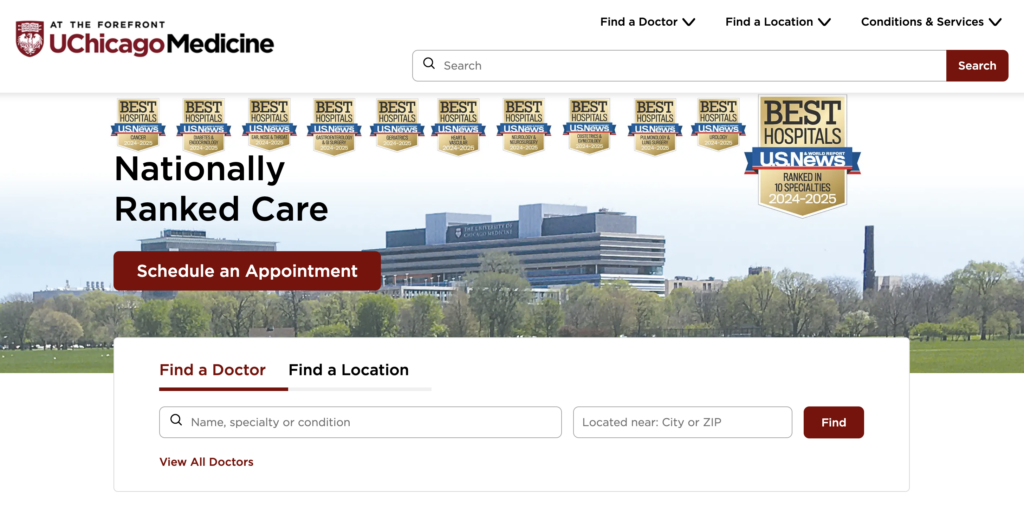
The University of Chicago Medicine makes their search bar prominent and accessible with SearchStax Site Search powering their main Find a Doctor and Find a Location functions.
But site search optimization goes beyond visibility. Your results page gives digital marketers an opportunity to surface relevant information and follow search UX best practices, to highlight key content and make it easy to find what the patient is looking for.
Regardless of what a patient is searching for information on, an optimized search should direct them to relevant blog posts, treatment details, doctor bios and even scheduling options—all in one place.
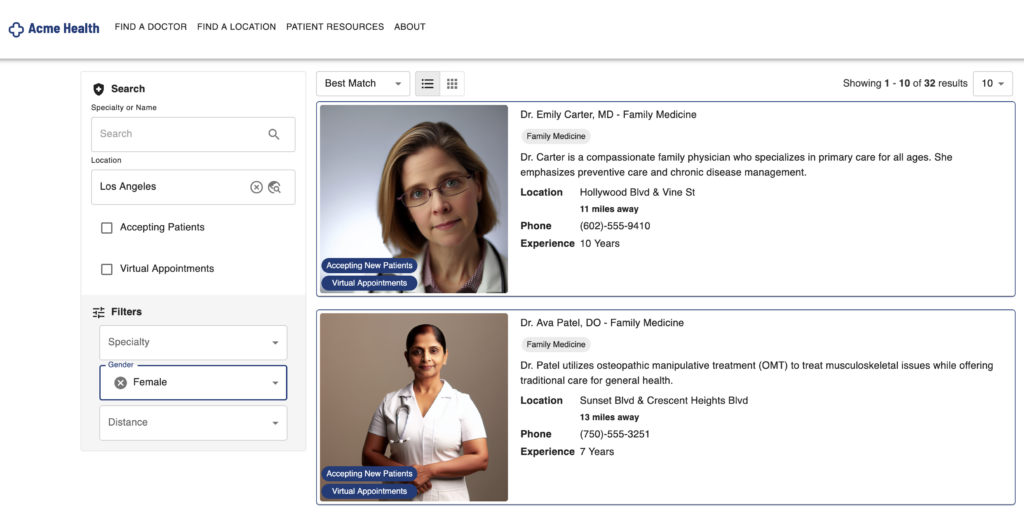
Personalization and Site Search: A Winning Combination
It’s also essential that your site search be equipped to understand what your patients need to find, even if what they type into the search bar isn’t perfectly spelled or accurate. Let’s face it, healthcare is a complex world where not everything is intuitive to spell or understand.
For example, if a patient types a description of symptoms, your site search may surface content based on the deeper meaning of the search. SearchStax Smart Ranking helps marketers do just that by leveraging advanced language processing to grasp the meaning of search phrases and provide contextual understanding beyond simple keyword-matching, and pushes the most meaningful content to the top of your site search results page.

Integrating Technology for Better Digital Experiences
Advanced site search tools, powered by machine learning and artificial intelligence, can significantly improve the user experience. For example, by analyzing past search behaviors and patient interactions, site search engines can predict what patients are most likely to be looking for, even before they finish typing. This predictive search capability can speed up the patient journey, ensuring they access the information they need with minimal effort.
Four Steps for Incorporating Site Search Into Your Digital Marketing Strategy
- Map the Patient Journey: Analyze the typical steps patients take when interacting with your website. Identify critical moments when they would benefit from easy access to relevant information, such as finding treatment options or scheduling a visit.
- Optimize Content for Search: Ensure that the content on your site is not only high quality but also optimized for search engines. This includes using relevant keywords, tagging images, and structuring content for easy indexing by search engines. Additionally, enhance your site search engine to surface the most relevant and high-quality content.
- Use Data to Improve the Search Experience: Collect and analyze data from your site’s internal search feature. Which queries are patients making most frequently? Are there gaps in the search results? By monitoring this data, you can continually improve your search functionality and ensure it aligns with patient needs.
- Leverage AI and Automation: Integrate AI and automation tools with your site search to surface more relevant results and deliver a positive personalization impression by responding to in-the-moment requests for information, without compromising patient privacy.
A Search-First Approach to Healthcare Marketing is a Must-Have
Incorporating internal site search into your healthcare organization’s digital marketing strategy is no longer a luxury—it’s a necessity. A seamless, optimized search experience can significantly enhance patient satisfaction, improve engagement and ultimately lead to better health outcomes. By focusing on providing patients with the information they need quickly and efficiently, healthcare providers can position themselves as trusted, patient-centered organizations.
As you refine your digital marketing strategy, make sure that internal site search is not an afterthought. It needs to be an essential tool that can streamline the patient journey, enhance content discovery, and personalize patient interactions—empowering your patients while boosting your organization’s digital presence.
Learn more about SearchStax Site Search for healthcare providers.

Growth marketing leader focused on building scalable acquisition engines, optimizing website performance, and turning complex technical concepts into clear, compelling stories that drive measurable business results.